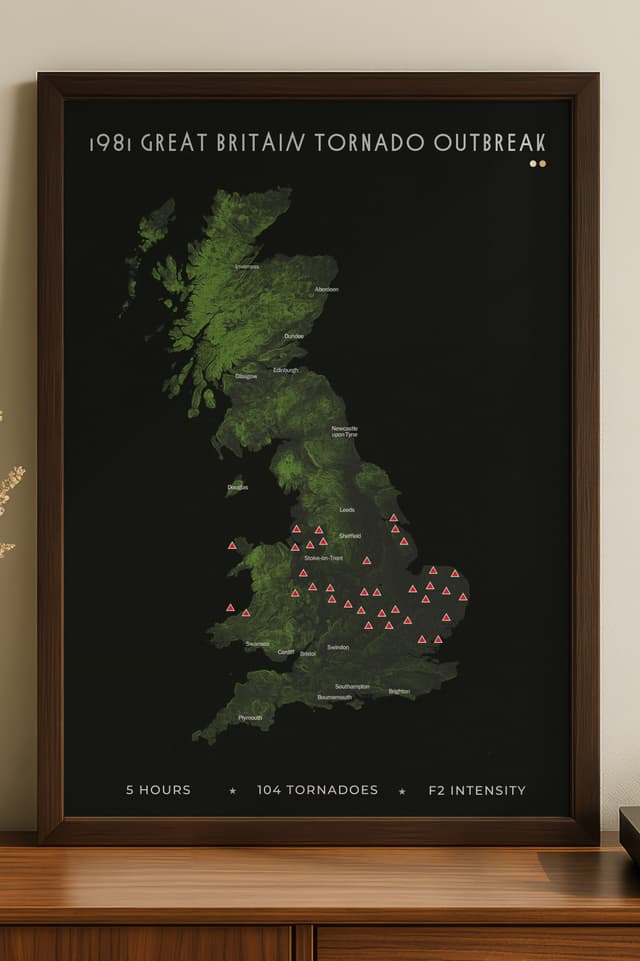
1981 UK Tornado Outbreak
104 confirmed tornadoes in approximately five hours. Not in the Great Plains. Not in Tornado Alley. In Britain, across a corridor stretching from Wales through the Midlands to East Anglia. On November 23rd, 1981, the United Kingdom experienced one of the most extraordinary tornado outbreaks ever recorded anywhere on the planet. Almost nobody knows about it.
Why the UK Gets Tornadoes at All
The United Kingdom actually has more tornadoes per unit area than the United States. That statement surprises most people, but it is well-established in the climatological literature. The UK sits at the convergence of Atlantic maritime air and Continental European air masses. The temperature and moisture contrasts across this boundary, particularly during autumn and winter, create conditions that produce small-scale rotating storms with reasonable frequency.
The critical difference is intensity. American tornadoes are often produced by large supercell thunderstorms drawing energy from the warm Gulf of Mexico across thousands of miles of flat terrain. British tornadoes are overwhelmingly weak, rated F0 or F1, produced by smaller-scale convective systems. They damage fences and garden sheds. They do not typically destroy towns.
But 1981 was not typical.
What Happened on November 23rd
A fast-moving cold front swept across the British Isles during the afternoon and early evening. Ahead of the front, unusually warm air for late November sat across England and Wales. The temperature contrast along the frontal boundary was sharp, and the wind shear was sufficient to generate widespread rotation within the convective line.
The tornadoes formed in rapid succession along the frontal boundary as it pushed east. They tracked across a corridor running roughly from the Welsh borders through the West Midlands, across the East Midlands, and into East Anglia. Most were on the ground for very short periods. Many lasted less than a minute. But the sheer number occurring within such a compressed time window was extraordinary.
104 tornadoes were confirmed across the event. Most were rated F0 or F1 on the Fujita Scale. Several reached F2, producing more significant structural damage. There were injuries and property damage, but remarkably, no deaths.
How It Compares Globally
The density figure is what makes the 1981 outbreak genuinely significant in global meteorological terms. 104 tornadoes in roughly five hours across a geographic area the size of a large US state is an extraordinary concentration by any standard.
Per unit area and per unit time, this event ranks among the most intense tornado outbreaks recorded anywhere. The United States has produced larger outbreaks in terms of raw numbers, the 1974 Super Outbreak had 148 tornadoes and the 2011 Super Outbreak exceeded 360. But those events were spread across far larger geographic areas and longer time windows. The density of the 1981 UK event is in a class of its own.
This is not an exaggeration or an attempt to inflate a minor weather event. The 1981 UK outbreak is genuinely remarkable within the global tornado record.
Why Almost Nobody Knows About It
Several factors contribute to the low public awareness of this event.
The tornadoes were weak. No one died. In a news cycle, tornado outbreaks become major stories when they produce casualties and dramatic destruction. An outbreak of F0 and F1 tornadoes that damaged roofs and overturned vehicles does not generate the same media response.
It happened in 1981, before 24-hour news cycles and the internet. Regional newspapers covered local damage, but there was no mechanism for the national or international media to recognise the aggregate significance of events happening simultaneously across the country.
Most fundamentally, the UK has no cultural framework for thinking of itself as a tornado-prone country. When people hear "104 tornadoes in 5 hours," they think of Oklahoma or Kansas. The idea that this happened in the Midlands does not fit the existing mental model, so it tends to be dismissed or forgotten.
What It Tells Us
The 1981 UK outbreak is a useful reminder that severe weather does not always happen where we expect it. The atmospheric mechanisms that produce tornadoes exist globally, and concentrated outbreaks can occur in places that do not build their identity around them.
It also demonstrates the limitations of how we record and remember weather events. If this outbreak had occurred in the United States, with the same tornado density applied to an equivalent area, it would be one of the most discussed events in storm chasing history. It happened in Britain, so it is a footnote.
We mapped the 1981 UK Tornado Outbreak as a cartographic print in the Fujita Supply style. It is in the shop.